About This Project
Every oyster that humanity has consumed started as a miniscule larva, invisible to the naked eye. During the Trochophore through Pediveliger stage of oyster larvae, they are most susceptible to starvation and contamination. We hypothesize that the novel phytoplankton blend will result in higher survival and settlement rates of oyster larvae compared to the industry-standard algal concentrate. This project aims to help local oyster farms in California achieve cheaper larval maintenance.
Ask the Scientists
Join The DiscussionWhat is the context of this research?
The oyster market represents over 4 billion dollars annually. In order to produce viable spat capable of turning into marketable oysters, they need to be fed a varied microalgae blend.
Oysters are unable to synthesize enough sterols and other fatty acids to survive; failure to provide larvae with sufficient polyunsaturated fatty acids results in deformities. Microalgae blends are preferred over monocultures as they introduce a more varied lipid profile, but the chosen species must together cover EPA, ARA, and DHA fatty acid profiles. Metamorphosis of the Pediveliger stage to spat is extremely energy intensive and is where reserves of neutral lipids (Triglycerides) are required to survive the 48 hour period, with a 41-91% survival rate. Furthermore, I have introduced a novel idea of tailored stage-specific feeding, which reduces energy expenditure on rejecting microalgae that are too large.
What is the significance of this project?
Going back to the stage-specific feeding, newly hatched oyster larvae have a feeding organ called a velum, which is a ciliated organ used to ingest microalgae. However, this organ can only ingest phytoplankton 5-8 microns, meaning anything bigger is wasted.
My idea is to assign ratios of microalgae that are ingestible by a given stage of larvae.
For example, the D-Stage larvae ratio should be 50% Isochrysis, 25% Pavlova, and 25% Rhodomonas for accessible cell size and polyunsaturated fatty acids. Using this novel formulation and feeding method, I want to compare this live blend to a whole cell concentrate primarily used by oyster hatcheries today.
This research is significant to help bivalve hatcheries as a whole achieve increased settlement rates and survival rates. By making our data open source, hatchery managers will be able to feed their bivalve larvae at a lower cost than purchasing concentrates while ensuring comprehensive nutrition at all life stages.
What are the goals of the project?
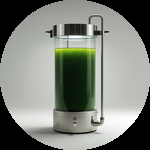
Firstly, I will culture 5 strains of the algae on a 12:12 grow cycle in aerated saltwater 1 gallon carboys fed with F/2 Medium. There will be 10,000 larvae in two separated liter mason jars with aeration. One group will be fed with recommended feeding dosage of the algae concentrate, the other will be my strained 5-strain phytoplankton blend at 3 million cells per mL.
I will then assess settlement rates and survival rates using averages per mL using a microscope.
Budget
I have some materials already to help start my algae experiment. As a fifteen-year-old student, over $700 is a big ask; however, any potential backers can be assured that I will use the funds for this experiment only.
I will need to first culture the microalgae in gallon beakers under 12:12 light cycle with continuous aeration in a shed outside. Renting a lab space is extremely expensive. I will then determine the optimal cell density to achieve the desired microalgae ratio for the oyster larvae. Immediately, I will acclimate the oyster larvae in a container with the needed environmental factors. I will then compare the survival rates between oyster larvae grown with a market-ready concentrate to my live phytoplankton mixture.
Endorsed by
 Project Timeline
I will first grow the algae cultures for 10 days and filter through a micron mesh in order to collect enough biomass. Then I will run the comparison between oyster larvae grown with and without my mixture. This will take around two weeks for collectable data. I will also post frequent observations every week for backers, and the final results will be posted publicly on my website. Backers will get exclusive behind the scenes material and more.
May 05, 2026
Grow algae cultures
May 13, 2026
Project Launched
May 28, 2026
Feed to oyster population
Jun 10, 2026
Report Results
Meet the Team

Cameron Orr
I started off interested in biology at around the age of ten trying to understand the immune system. However, I currently am extremely excited about the opportunities in algal biotechnology in real-world applications. As a result, I founded Orr Biologicals to help aquaculture hatcheries optimize their phytoplankton feedings.
I have taken three UCSD extension courses in microbiology to challenge and deepen my learning. This is why I always read scientific literature in my free time.
Lab Notes
Nothing posted yet.
Additional Information
This experiment looks to formulate a novel phytoplankton blend that contains five microalgae and diatom species. Going back to the stage-specific feeding, D-Stage Larvae (Newly Hatched Larvae) can only ingest algal particles 2-7 microns due to their ciliated velum (Feeding Organ) and esophagus.
In our phytoplankton mixture feeding sequence, I plan to assign ratios of microalgae that are ingestible by a given stage of larvae. For example, the D-Stage larvae should be 50% Isochrysis, 25% Pavlova, and 25% Rhodomonas to help early velum development and digestible particle size. Using this novel formulation and feeding method, I want to compare this live blend to a whole cell concentrate primarily used by oyster hatcheries today.
This research is significant to help bivalve hatcheries as a whole achieve increased settlement rates and survival rates. By making this data open source, I can help reduce mortality in larvae.
Project Backers
- 1Backers
- 2%Funded
- $10Total Donations
- $10.00Average Donation