About This Project
Urban development is changing coastal waterways, altering salinity and pollution in ways that affect marine life. I study bioluminescent bacteria living inside cardinalfish in Australia and found that bacteria from polluted areas carry far more mobile DNA elements, which copy themselves across the genome and disrupt normal bacterial functions. I hypothesize that environmental stress drives this, and I will test it by sequencing bacterial communities across a salinity/pollution gradient.
Ask the Scientists
Join The DiscussionWhat is the context of this research?
Urban development is altering coastal waterways, exposing marine bacteria to novel salinity fluctuations and environmental pollutants. One response that bacteria have to combat this stress is the proliferation of mobile DNA elements, which can allow rapid adaptation to changing environments but also disrupt normal gene function.
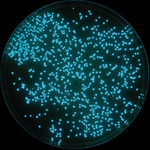
I study the bioluminescent symbiosis between cardinalfish and their bacterial partner Photobacterium mandapamensis, which lives in the fish's light organ and produces light used to evade predators. When I sequenced these bacteria from Sydney Harbour, I found a dramatic proliferation of mobile elements in bacteria from more polluted sites. Prior work shows that these elements can be activated by stress, but whether this occurs in coastal marine ecosystems is unknown. I hypothesize that environmental stress triggers this proliferation, and that mobile element density scales with environmental stressors.
What is the significance of this project?
Insertion sequences (IS) are a major engine of rapid bacterial evolution, as they can help spread useful traits but also disrupt important functions. This project will reveal whether salinity and pollution levels in coastal waters can directly trigger IS activity, giving biologists, conservationists, and lawmakers a new lens for understanding how urbanization affects bacterial communities. It would also raise an important practical question: if what we put into coastal waters is triggering large-scale genomic changes in bacteria, we may need to rethink how we assess the biological impact of urban runoff and pollution. By connecting genomics, microbial ecology, and environmental change across a salinity and pollution gradient, this project generates data directly relevant to bacterial adaptation in an era of increasing coastal urbanization and climate-driven salinity shifts.
What are the goals of the project?
This project aims to determine whether environmental stressors in coastal areas increase the number of insertion sequences in marine bacteria. My Australian collaborators will collect water samples at 4 sites along the Sydney Harbour estuary transect, spanning a salinity and pollution gradient from approximately 0 ppt (freshwater/urban runoff) to 35 ppt (open marine). After receiving the samples, I will perform long-read metagenomics to test whether IS density in bacterial communities correlates with salinity or pollution levels. All samples will be multiplexed and sequenced in a single Oxford Nanopore MinION run, expected to generate approximately 10–12 Gb of data total. Long-read sequencing is essential because IS elements are repetitive and short-read technology cannot reliably resolve them. If a signal emerges, this will form the foundation for experimental evolution work testing what stressors directly cause IS expansion in the lab.
Budget
I have existing collaborators in Sydney that have the materials and expertise needed to collect water samples along river transects spanning a salinity gradient and filter for bacteria. The funding I need covers what happens once those samples arrive in my lab. I am requesting funds to extract high-molecular-weight DNA from the filtered water, which is essential for long-read sequencing to work effectively, and running that DNA through Oxford Nanopore long-read sequencing. Long reads are necessary here because insertion sequences are not picked up reliably by other types of genomic sequencing. This funding covers the extraction reagents, sequencing flow cell, library preparation kits, and international shipping, letting me turn field-collected samples into complete, high-quality genomes I can compare across the gradient.
Endorsed by
 Project Timeline
Once funded, my Australian collaborators will collect water samples along the estuarine transect and ship extracted DNA to my lab in Philadelphia. I will then prepare sequencing libraries and run long-read metagenomic sequencing on our in-house Oxford Nanopore MinION. Bioinformatic analysis will follow, and results will be shared with backers via a project update.
Aug 28, 2026
Project Launched
Dec 01, 2026
Water samples collected across salinity gradient by Australian collaborators
Dec 15, 2026
Samples shipped to home lab
Jan 20, 2027
DNA Extractions Completed
Feb 01, 2027
Long-read metagenomic sequencing completed
Meet the Team
Hannah's Google Scholar Profile
Hannah Osland
I'm Hannah Osland, a PhD student in biology at Temple University in Philadelphia, where I study fish and the glowing bacteria that live inside them.
I have always loved the water, which is what led me to want to study marine life and how big and small beings interact with each other. I received my bachelor's degree in Biology from Pomona College, and my master's in environmental science degree from Alaska Pacific University. Like many scientists, I have been affected by recent reductions in funding, but still want to be able to try and answer some of the questions I have.
Lab Notes
Nothing posted yet.
Additional Information
This funding covers the specific bottleneck between field collection and data: DNA extraction reagents for processing filtered water samples, international shipping of samples from Australia to my lab in Philadelphia, and the Oxford Nanopore sequencing consumables (flow cell and library preparation kits) needed to generate long-read metagenomic data. My collaborators have already committed to the fieldwork, this money gets those samples sequenced.
Project Backers
- 3Backers
- 7%Funded
- $135Total Donations
- $45.00Average Donation