About This Project
This study explores soil-based microbial fuel cells (MFCs) enriched with electroactive methanotrophs to reduce methane flux in paddy soils while generating electricity. The MFCs manipulate soil redox states, promoting methane oxidation and potentially minimizing other emissions like N₂O and H₂S, contributing to a reduction in greenhouse gases. The system also improves soil quality and can be easily monitored and controlled through external circuitry, offering a sustainable and scalable solution.
Ask the Scientists
Join The DiscussionMotivating Factor
CH4 emissions have contributed ~0.5 ˚C of global warming to date (IPCC, 2023), and natural sources may increase via feedback to warming (Zhang, 2023). Agriculture is the leading human-induced source of methane, contributing 145 Tg of CH4 per year to the atmosphere (Smith, 2021). A significant portion of this methane arises from rice cultivation. Rice fields spanning approximately 1.7 million km² account for around 11% of global agricultural N2O emissions and 30 % of agricultural CH4 emissions (Khatibi, 2025). It is important to reduce global agricultural methane emissions to ensure that the Paris Agreement goals can be met (Rogelj, 2024). Methane is released from paddy fields when the soils are submerged, creating oxygen-deprived conditions that support the growth of methanogenic microbes producing CH4. Although methane-oxidizing bacteria can reduce some of this CH4, there remains a substantial overall emission from rice paddies (Yan, 2009).
Specific Bottleneck
Many strategies have been developed to reduce soil methane emissions, but these efforts can sometimes have unintended consequences, such as increased N2O or CO2 production, which may diminish or even reverse the intended positive impact on climate change (Stein, 2024). This is largely due to the complex interactions within the microbial communities in the soil. Soil itself is an intricate, heterogeneous matrix characterized by electrochemical and nutrient gradients, which is continuously influenced by growing plant roots (Aleklett, 2017, Arredondo, 2024). The availability of nutrients and electron acceptors in specific micro-niches within the soil is largely determined by the localized redox state, shaping the microbial community (DeAngelis, 2010). However, this critical aspect is often overlooked in studies, mainly due to the lack of tools capable of resolving these gradients continuously without disturbing the system. As a result, mitigation strategies remain incomplete.
Actionable Goals
The first goal is to enable active control of greenhouse gas emissions by externally regulating microbial processes with minimal intervention. This requires developing a system that can dynamically adjusts to optimize methane oxidation and minimize unwanted emissions.
The second goal is to take into account the full spectrum of emissions, including methane, N₂O, and CO₂ instead of focusing on a single greenhouse gas. This holistic approach ensures that mitigation strategies do not inadvertently increase other greenhouse gases, leading to a more effective and balanced solutions.
Soil microbial processes are highly dependent on fine-scale chemical and redox gradients. The third goal is to use appropriate tools to measure their spatial and temporal variations. This will enhance our understanding of soil dynamics. Most importantly, it will help optimize the system for in-situ conditions, ensuring more effective and targeted emissions control.
Budget
The budget helps in buying research equipment, consumables, and paying the salary of a technician who is skilled in making microsensors.
Meet the Team
Affiliates
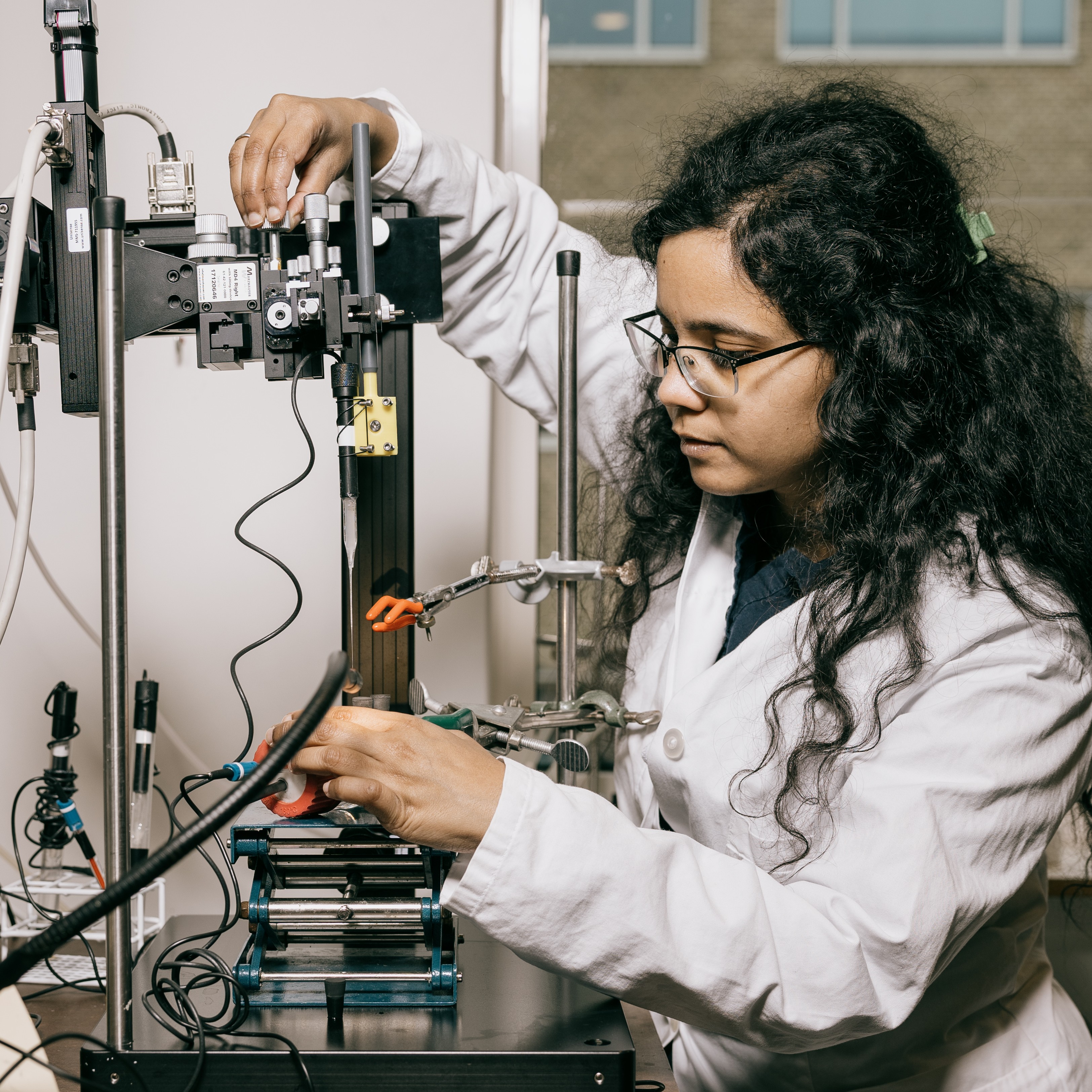
This project is led by Ramya Veerubhotla, a postdoc at Aarhus University specializing in microbial fuel cell design, alongside Ugo Marzocchi, an expert in soil biogeochemistry and 'electrochemical snorkels'. Senior professors Hans Brix, specializing in methane emissions from aquatic systems, and Lars Peter, who studies cable bacteria and methane mitigation, further strengthen the team. Together, we aim to explore methane reduction through electroactive microbes comprehensively.
Ramya Veerubhotla
I've always been fascinated by electroactive microbes - tiny organisms with the power to transfer electrons and drive biochemical reactions. This curiosity led me to explore the fascinating field of electro-microbiology, and biofuel cells, shaping my journey as a Postdoctoral Fellow at Aarhus University. I am currently a Novo Nordisk Foundation Postdoctoral Fellow working on the project titled "Power-to-Ammonia: Unleashing the Power of Microbes to Produce Green Ammonia using Bio-Electrochemical Hybrids." My research focuses on leveraging electroactive microbes for sustainable and green ammonia production.
With a Ph.D. from IIT Kharagpur, my work focuses on harnessing microbial electrochemical technologies to tackle environmental challenges. From developing paper-based bio-batteries to developing robust bio-electrodes for green transition, I strive to bridge microbiology and electronics for sustainable solutions. In 2018, I received the Platinum Award (along with 1 million INR funding) at the National Design and Innovation Contest (KPIT Sparkle) for a Paper Battery innovation that generates electricity from bacteria and waste, which has been a valuable experience in exploring alternative energy solutions.
I’m driven by the challenge of turning fundamental science into real-world applications—where microbes and electrons meet innovation.
Hans Brix
Expertise in plant ecophysiology, freshwater ecology, and wetland management. Research focuses on aquatic plant ecophysiology and biogeochemical cycling in wetlands. Studies span ecosystem, community, and individual plant levels, with emphasis on invasive species and global change effects on coastal marshes. Applied aspects involve natural, restored, and constructed wetlands for water purification.
Ugo Marzocchi
My scientific interest lies at the intersection between ecology, biogeochemistry, and electrochemistry. The focus of my research is on the main factors that regulate macronutrients (C, N, P, S, Fe) cycling in marine and freshwater sediments, and prominently on the role of bacteria able to mediate electric currents. My work on this topic covers different aspects spanning between their metabolism, geochemical impact, diversity, and lastly, on how such electrogenic capabilities can be used to stimulate degradation of contaminants in sediments. I address these topics primarily by applying isotopic tracers and sensing techniques such as microelectrodes and planar optodes.
Lars Peter Nielsen
My research has always circulated around life and element cycling at oxic-anoxic interfaces. After many years with nitrogen cycling, microsensors and agricultural gasses, I accidentally discovered electric currents connecting microbial processes over centimeter distances. The mediator turned out to be long, multicellular bacteria with internal electrical wires. To understand and eventually apply these cable bacteria is the aim of Center for Electromicrobiology that I am heading.
Project Backers
- 0Backers
- 0%Funded
- $0Total Donations
- $0Average Donation