About This Project
This project tests if a climate-controlled Slovenian AŽ-style bee house reduces colony losses and boosts productivity versus traditional open-air beekeeping in Tennessee. We hypothesize that microclimate control (~80°F, 55–65% RH, ~1,000 ppm CO₂) via protected containment stabilizes conditions and cuts bee energy used for thermoregulation. Monitoring 24 Carniolan colonies with sensors and cameras against US benchmarks will show if this improves survival and honey yields.
Ask the Scientists
Join The DiscussionWhat is the context of this research?
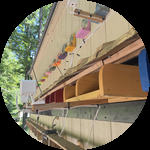
This project compares traditional open-air beekeeping in Tennessee with a protected, climate-controlled bee house design commonly used in Slovenia. Both places have mountains, forests, and changing weather, but Tennessee beekeepers experience much higher colony losses. We built an off-grid research station inside a modified Slovenian-style bee house equipped with sensors and cameras. The study tests whether keeping hives in a stable, sheltered environment can reduce stress from temperature swings, moisture buildup, and weather extremes that often harm colonies in regular outdoor hives. By collecting real data on colony health and survival, we want to see if this approach could be practical and helpful for beekeepers in the Appalachian region.
What is the significance of this project?
This research will generate practical data on whether a climate-controlled bee house can help honey bee colonies survive better in Tennessee’s variable climate. We’re measuring internal hive conditions (temperature, humidity, and CO₂), colony activity through cameras, and overall survival and honey production. These measurements will show whether stable conditions reduce the energy bees spend fighting weather and moisture, allowing them to focus more on raising brood and collecting food. The results could offer beekeepers a clearer picture of how protected environments affect colony health and may provide a useful model for reducing winter losses in the southeastern U.S.
What are the goals of the project?
Our main goal is to test whether a climate-controlled Slovenian-style bee house can improve colony survival and productivity compared with conventional open-air beekeeping in Tennessee. We’ve set up 24 Carniolan colonies inside the bee house and are maintaining steady conditions around 80°F, 55–65% humidity, and roughly 1,000 ppm CO₂. We want to see if this stable environment reduces stress on the bees so they can put more energy into brood rearing and foraging instead of constantly managing temperature and moisture. Success will be measured by higher winter survival rates, better honey production, and stable internal hive conditions compared with typical Tennessee results.
Budget
This budget purchases bee packages with mated queens, cameras, and a solar-powered generator to establish and monitor 24 colonies in a climate-controlled Slovenian AŽ-style bee house. These items are required to maintain stable environmental conditions and collect data comparing the protected model to conventional open-air beekeeping in Tennessee.
Endorsed by

 Project Timeline
Phase 1, beginning on January 1, 2026, is dedicated to fabrication and component mockup. Phase 2 runs from May 16 through July 1, 2026, and focuses on establishing energy infrastructure and ambient monitoring systems. Phase 3 involves biological launch and data systems activation, running through July 31, 2026. Phase 4 runs through April 1, 2027, and captures late-season baseline and overwintering data. Phase 5 consists of an active apiary research cycle running through October 31, 2027.
May 15, 2026
Milestone 1: Environmental Stabilization & Systems Validation (May 15, 2026)Milestone has been achieved,the bee house is fully integrated and functional.
Jul 13, 2026
Project Launched
Jul 31, 2026
Milestone 2: Baseline Data Sync & Biological Launch ( July 31st,2026) Milestone 24-3lb packages are in their hives and the data loop is verified live.
Jul 31, 2026
Milestone 3: Data systems activation window spanning This includes sensor and camera set up and development of Internet Dashboard to July 31.
Aug 31, 2026
Milestone 4: Develop the flow curve for nectar, analyze camera history and document by timeline pollen type
Meet the Team

Affiliates

Affiliates
Mark Davis
Mark Davis as executive director of Makers IP optimizes a 50 year personal history and notebooks of skills related knowledge. The Makers IP team will pass on thru a relevant network-accessible resource knowledge that enables Makers, Vehicle Builders, Engineers, Fabricators, Traditional Craftsman, Manufacturers, Collegiate Academia, and Product Assemblers to enhance their crafts with aggregate information from multiple sources. Makers IP vision includes but is not limited providing guidance in all aspects of hands-on skills, related tools, equipment, crafts and imagination. The portal guides Makers through a labyrinth of adventures without the financial burdens that are a byproduct of imagination and impatience.
Project Design Engineer, Makers IP LLC, Full-time, Jul 2025 – Present, 1 yr –Monterey, Tennessee, United States, On-site
Automotive Design Technician College of Engineering Tennessee Technological University, Full-time, Jan 2022 - Aug 2025, 3 yrs 8 months –Cookeville, Tennessee, United States, On-site
Academic Support Associate 8, Department of Civil and Environmental Engineering, Tennessee Technological University, Full-time, Nov 2011 - Aug 2025 · 13 yrs 10 months –Cookeville, Tennessee, United States, On-site
As Academic Support Associate 8 duties included: undergraduate and graduate research supervisor. CEE Structural & DENSO Power N2 Motion lab/shop supervisor, equipment specific skills and safety instructor. Academic Support Associate for ASCE Collegiate Design Competitions Academic Support Associate for AISC Steel Bridge Collegiate Design Competitions Academic Support Associate for TNTech Motorsports FSAE program. Facilitates the "Makers By Design", STEM outreach program for COE, Faculty Adviser for the Michigan FSAE Collegiate Design Competition Academic Support Associate for Capstone Project Refinishing and Tubular Fabrication. In-house consultant on automotive industry trends, transportation research & product line evaluation.
Cynthia Davis
Strategic communications professional with 30+ years of experience delivering creative, accessible, and impactful digital content across higher education, motorsports, and nonprofit sectors. I specialize in graphic design, web content management, multimedia design, and accessibility compliance—combining creative ideation with data-driven strategy to engage diverse audiences. My background spans branding, print and digital advertising, SEO, social media management, trade show execution, and procedural development. I’m passionate about translating complex ideas into clear, engaging content.
Additional Information
As beekeepers living and working on a family farm in the Cumberland Plateau of Tennessee, we’re motivated by both the challenges we see in local apiaries and the traditional, low-impact methods used successfully in other regions. This research combines modern monitoring tools with time-tested design to support healthier colonies while respecting the practical realities of Appalachian beekeeping.
Project Backers
- 6Backers
- 4%Funded
- $281Total Donations
- $46.83Average Donation